Preparation
UPSC ESE 2027 Prelims: Exam Date, Pattern and Preparation Guide
UPSC ESE 2027 Prelims is scheduled for 31 January. Check the official timeline, application status, exam stages, revision plan and candidate checklist.
- Published
- Reading time
- 8 min read
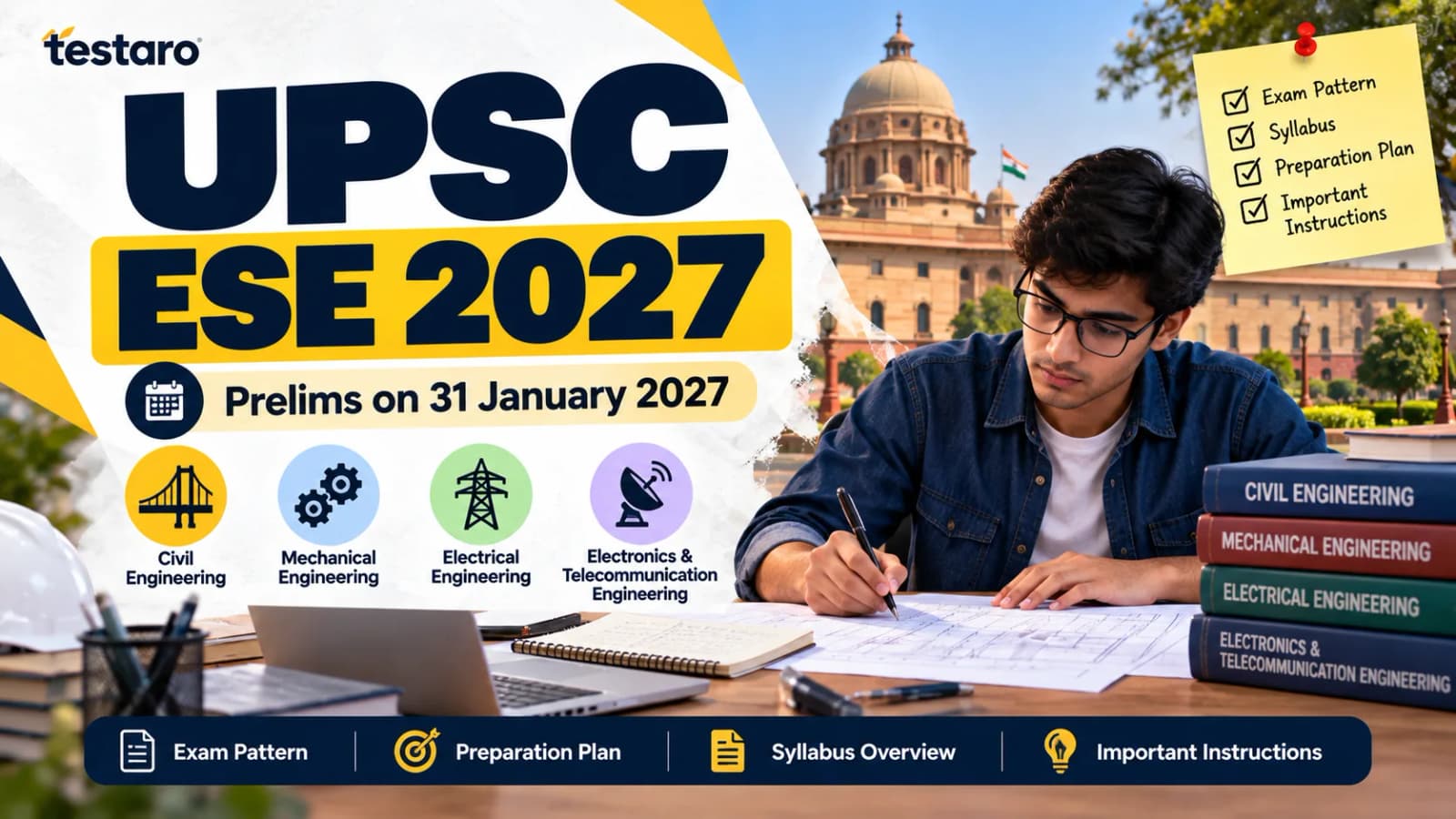
Table of contents
UPSC ESE 2027: Official exam date and current status
The Union Public Service Commission (UPSC) has scheduled the Engineering Services (Preliminary) Examination, 2027 for 31 January 2027. The examination notice was issued on 16 September 2026 under Notice No. 02/2027-ENGG. The application deadline was 6 October 2026 at 6:00 PM.
As of 31 October 2026, the application window has closed. This guide is therefore intended for candidates who submitted their applications in time and are now preparing for the Preliminary Examination. It is not an invitation to apply, and candidates should not rely on unofficial websites claiming that a fresh application window is open.
Official UPSC examination page: https://www.upsc.gov.in/examinations/Engineering%20Services%20%28Preliminary%29%20Examination%2C%202027
UPSC ESE 2027: Important dates
| Event | Official schedule |
|---|---|
| Notification issued | 16 September 2026 |
| Online application opened | 16 September 2026 |
| Last date to apply | 6 October 2026, 6:00 PM |
| Application status on 31 October 2026 | Closed |
| Preliminary Examination | 31 January 2027 |
| Admit card | Release date not announced in the official page reviewed |
| Further examination-stage updates | Check UPSC notices and the active examinations page |
The UPSC active examinations page lists Engineering Services (Preliminary) Examination, 2027 with Notice No. 02/2027-ENGG and the 31 January 2027 examination date. Candidates should check that page for any later notice, timetable, admit-card announcement or corrigendum.
Official active examinations: https://cms.upsc.gov.in/active-examinations/
What is the Engineering Services Examination?
The Engineering Services Examination (ESE) is a UPSC selection process for engineering-related services and posts in the Central Government. The examination is organised around engineering disciplines such as Civil, Mechanical, Electrical, and Electronics & Telecommunication Engineering. The exact service, post and qualification mapping must be checked in the official 2027 notification.
The examination is not a general engineering aptitude test alone. Candidates need to prepare for the General Studies and Engineering Aptitude component as well as the technical paper for their chosen engineering discipline.
If you applied, keep a copy of the submitted application and the 2027 notice available while preparing. The notification is the controlling document for eligibility, post preferences, documents, examination instructions and any discipline-specific conditions.
Understand the selection stages
UPSC ESE is conducted through three broad stages:
- Preliminary Examination: objective-type papers. It is the first screening stage and includes General Studies and Engineering Aptitude along with the discipline-specific engineering paper.
- Main Examination: conventional written papers in the relevant engineering discipline for candidates who qualify at the Preliminary stage.
- Personality Test: the interview stage for candidates who qualify in the written stages.
The official UPSC material describes these three stages. Candidates should read the 2027 examination notice and the current syllabus before relying on any older pattern summary. Marks, paper details and eligibility conditions should always be checked against the notification applicable to the 2027 cycle.
UPSC's official annual report provides a description of the ESE's three-stage structure: https://upsc.gov.in/sites/default/files/73rd-AnnualReport-2022-23-Engl-220824.pdf
How to prepare for UPSC ESE Prelims 2027
With the Preliminary Examination scheduled for 31 January 2027, candidates should move from broad syllabus coverage to timed revision and question practice. A useful plan has five parts.
1. Recheck the official syllabus
Download the syllabus and examination notice from UPSC. Mark each topic as:
- Not started
- Studied once
- Needs revision
- Ready for timed practice
Do not build your entire plan from a coaching checklist or an old PDF. Confirm that the subject headings and paper instructions match the 2027 notification.
2. Divide preparation between the two paper areas
Plan dedicated time for General Studies and Engineering Aptitude and for your chosen engineering discipline. The technical paper needs consistent problem-solving practice; the general paper needs regular revision and question practice.
Avoid spending the whole week on one paper area and leaving the other until the final month. A weekly timetable should include both.
3. Use previous question papers
Previous papers help you understand the way concepts are tested and the level of calculation or reasoning expected. Solve them topic-wise at first. Later, attempt complete papers under a time limit.
After each paper, record:
- Topics where you made conceptual errors.
- Questions lost through calculation mistakes.
- Questions that consumed too much time.
- Topics that need another revision cycle.
Do not judge preparation only by a mock-test score. The error analysis is what makes the next study session useful.
4. Practise time management
Timed practice is important because candidates must make decisions quickly without sacrificing accuracy. Build up gradually:
- Start with short topic tests.
- Move to mixed-topic tests.
- Attempt full-length mock papers.
- Review the paper on the same day.
- Reattempt incorrect questions after a gap.
Keep a realistic time limit and practise following the official examination instructions.
5. Maintain concise revision notes
Prepare short notes for formulas, standard results, important concepts and recurring mistakes. Keep separate notes for General Studies and Engineering Aptitude and for the technical discipline. The purpose is to make revision faster; avoid rewriting entire textbooks.
A practical revision plan up to 31 January 2027
The following is a suggested preparation framework, not an official UPSC timetable.
| Period | Main focus | What to complete |
|---|---|---|
| 31 October–15 November | Syllabus audit and weak areas | Identify gaps; revise high-priority technical topics; begin regular general-paper practice |
| 16–30 November | First structured revision | Finish planned topic revision; solve topic-wise previous questions |
| 1–15 December | Mixed practice | Combine technical and general-paper questions; begin timed sectional tests |
| 16–31 December | Mock-test phase | Attempt full papers; analyse accuracy, speed and recurring errors |
| 1–15 January | Second revision | Revise short notes, formulas and weak areas; take timed mocks |
| 16–25 January | Final consolidation | Avoid starting too many new resources; focus on accuracy and exam discipline |
| 26–30 January | Light revision and logistics | Review concise notes, confirm travel and exam instructions, rest properly |
Candidates should adjust this plan to their preparation level, work schedule and discipline. Someone who has already completed the syllabus should spend more time on timed papers and error analysis. Someone with unfinished topics should prioritise the official syllabus instead of collecting more study material.
How to use previous papers and mock tests effectively
A mock test is useful only when it leads to a change in preparation. After each attempt, classify every incorrect or skipped question into one of four groups:
- Concept not understood.
- Formula or fact not remembered.
- Calculation or interpretation error.
- Time-management decision.
Revise the underlying concept for the first two categories. For calculation errors, practise the relevant question type slowly before increasing speed. For time-management issues, set a clear rule for when to move on from a difficult question.
Maintain a simple record of mock date, score, accuracy, strongest topics and topics to revisit. Compare performance across several tests rather than reacting to one unusually high or low score.
What candidates should check before the exam
The admit-card release date was not announced on the official UPSC examination page reviewed for this update. Candidates should monitor the official UPSC website and active examination page instead of relying on messages or screenshots shared on social media.
Before travelling to the examination centre:
- Download the e-admit card when UPSC makes it available.
- Read the instructions printed on the admit card.
- Verify the candidate's name, roll number, date, reporting time and examination venue.
- Check which original photo identity document is accepted in the official instructions.
- Review the permitted and prohibited items list.
- Plan the route to the examination centre in advance.
- Keep the required documents ready the previous evening.
Do not assume that a previous year's admit-card instructions automatically apply to the 2027 examination. The current admit card and UPSC instructions are authoritative.
Common mistakes to avoid
- Searching for a new application link after the deadline: the published application window closed on 6 October 2026. Check UPSC for an official extension or corrigendum rather than trusting an unofficial form link.
- Ignoring the General Studies and Engineering Aptitude paper: technical preparation alone does not cover the full Preliminary Examination.
- Using an old syllabus without checking the 2027 notice: confirm the current discipline-specific syllabus and instructions.
- Taking mock tests without reviewing them: repeated errors will continue unless you analyse and revise them.
- Starting several new books in January: consolidate reliable resources and focus on practice.
- Waiting until the admit card to check logistics: plan travel and document readiness early, then follow the official instructions when released.
Official links for UPSC ESE 2027
- Examination notice and date: https://www.upsc.gov.in/examinations/Engineering%20Services%20%28Preliminary%29%20Examination%2C%202027
- Active examinations: https://cms.upsc.gov.in/active-examinations/
- UPSC examination calendar: https://cms.upsc.gov.in/examination-calendar/
- UPSC online application portal: https://upsconline.nic.in/
- UPSC main website: https://upsc.gov.in/
Use the application portal for candidate access where available, but use the UPSC notice and official website for confirmed announcements.
Frequently Asked Questions
UPSC has scheduled the Engineering Services (Preliminary) Examination, 2027 for 31 January 2027.
The notification was issued on 16 September 2026 under Examination Notice No. 02/2027-ENGG.
The last date was 6 October 2026 at 6:00 PM. The application window is closed as of 31 October 2026.
The published application deadline has passed. Candidates should not assume that a new application or late-fee window is available unless UPSC publishes an official extension or fresh notice.
The broad stages are the Preliminary Examination, Main Examination and Personality Test. Refer to the 2027 notification for the applicable paper details and rules.
The ESE is organised around Civil, Mechanical, Electrical, and Electronics & Telecommunication Engineering. Candidates must check the 2027 notice for the exact discipline, post and qualification mapping.
The official examination page reviewed for this update does not state an admit-card release date. Check the UPSC website and active examinations page for the official announcement.
Use the UPSC examination page at https://www.upsc.gov.in/ and its active examinations page at https://cms.upsc.gov.in/active-examinations/.
Last checked: 31 October 2026. This guide reflects the official notice and examination status available on that date. Any later UPSC corrigendum, timetable or admit-card instruction takes precedence.